

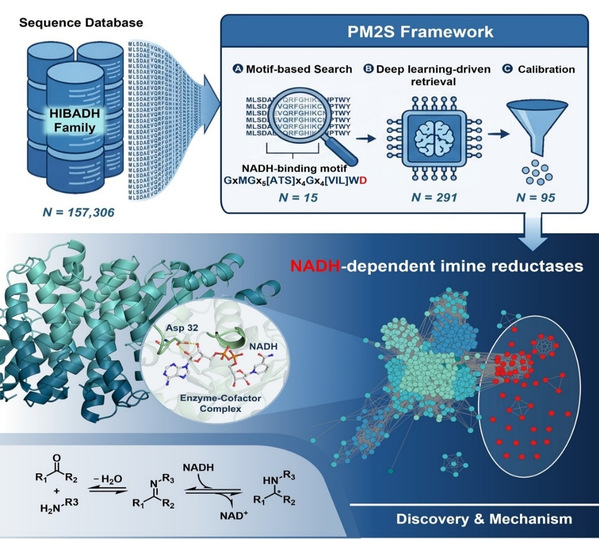
To overcome this limitation, the research team developed an intelligent enzyme mining strategy named PM2S (Protein Motif to Search), based on the conserved coenzyme-binding motifs of enzymes. This strategy integrates three modules: motif search, deep learning-driven iterative retrieval, and result calibration. From 150,000 gene sequences, 95 candidate natural NADH-dependent iminoreductases were successfully identified. Experimental results demonstrated that these candidate enzymes prefer NADH as a cofactor, catalyze imine reduction and reductive amination reactions, exhibit an exceptionally broad substrate spectrum, and have been applied to the synthesis of key intermediates for pharmaceuticals such as cinacalcet.
Mechanistic studies revealed that a key aspartate (Asp) residue in the cofactor-binding pocket is the core determinant of NADH preference. This residue forms a stable interaction with NADH, whereas the additional phosphate group of NADPH is unfavorable for binding due to steric hindrance and electrostatic repulsion. Site-directed mutagenesis of this residue completely reversed the cofactor preference. In summary, this study established a novel enzyme mining tool integrating local conserved motifs + deep learning, discovered a new class of naturally occurring NADH-dependent iminoreductases, and elucidated the regulatory mechanism underlying their cofactor preference, thereby laying a foundation for cofactor engineering and the construction of efficient biocatalytic systems.
