

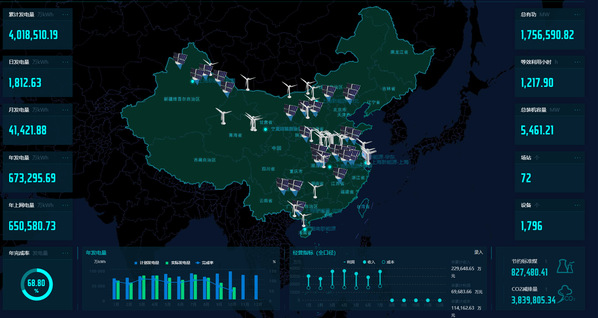
Energy serves as the driving force and infrastructure for urban operations, making the efficient production and service of integrated energy crucial for urban development and safety. Digital transformation has brought new opportunities for the development of smart city energy systems. However, significant technical challenges remain in terms of energy information accuracy and application synergy. Addressing the national dual carbon strategic goals and the development needs of the urban energy industry, this research proposes human-computer interaction-based urban energy data space construction and real-time digital twin decision-making techniques. These techniques enable knowledge representation, self-evolutionary computation, and online real-time digital twin decision-making for the large-scale, complex issues involving both humans and assets in urban energy systems. An industrial internet-based urban energy panoramic data space is constructed. The study researches and innovates real-time digital twin decision-making techniques built upon big data-driven continuous autonomous learning and multi-agent systems that simulate human behavior, thereby endowing energy network transmission and distribution systems as well as emergency response systems with digital intelligence. This work has led to the engineering realization of an intelligent energy system assurance platform, which has been successfully applied to the comprehensive collaborative optimization and green, efficient energy services of Shanghai's urban energy system. The research outcomes have been deployed in organizations such as Shenergy Group and Shanghai Gas Company, ensuring the security of energy supply and safe services for the city of Shanghai, and have yielded significant social and economic benefits.
